Monthly debit order or lump sum? Two ways to start investing
Whether you begin with a small monthly debit order or a single lump sum, the route your money takes into the market comes with its own trade-offs — and neither is right for everyone.
Key points
- A monthly debit order buys into the market at many different prices, which tends to smooth out the average price you pay.
- Automating the contribution can matter as much as the amount, because it takes the monthly decision away.
- A lump sum can be invested all at once or phased in over several months — each route has a cost and a comfort.
- An emergency fund generally comes first, so that a surprise does not force you to sell at a poor moment.
Investing a little every month
For most people, investing starts with a debit order: a fixed rand amount that leaves your bank account each month and buys into an investment such as a unit trust. The amount can generally be changed or paused as your circumstances change.
The prices of market-linked investments move every day, so the same amount buys more units when prices are lower and fewer when they are higher. Over time you buy at many different prices rather than at one, and the average price you pay tends to be smoothed out. This is often called rand-cost averaging.
Rand-cost averaging does not guarantee a profit, and it does not protect you from a loss if markets fall and stay down. What it can do is take away the pressure of picking the “right” day to invest, because you never rely on a single day.
Why automation helps
The less obvious benefit is behavioural. Money invested automatically is money you never have to decide about: no monthly debate about whether now is a good time, and no temptation to skip a month because the headlines are gloomy.
That matters: many investors tend to add money when markets have already risen and to stop when prices have fallen — the opposite of what helps them. A debit order carries on regardless, and in a weak market it simply buys more units for the same money.
Many people set the debit order to run just after payday, so that investing comes before spending rather than from what is left over.
When a lump sum comes along
Sometimes the money arrives all at once: a bonus, an inheritance, the sale of a property, or a payout from a retirement fund when you change jobs or retire. A few questions are worth settling first:
- What is the money for? The goal and the time you have tend to decide what may be appropriate.
- Is there expensive debt? Paying down short-term debt is often worth discussing first.
- Is there tax to consider? Some lump sums reach you after tax and others do not, so find out before you make plans.
Good to know
A payout from a retirement fund is a special case. Under South Africa’s two-pot retirement system, part of what you save must stay invested until you retire, so not all of a benefit can necessarily be taken in cash when you change jobs. Whatever is taken in cash can trigger tax and reduces your retirement savings, while a transfer to a preservation fund or a retirement annuity is generally not taxed at that point. At retirement the choices are different again, and most of the benefit is usually used to provide an income. The rules change from time to time and some choices cannot be reversed — so ask an adviser before the money is paid out.
All at once, or phased in?
A lump sum meant for long-term investing can broadly go to work in two ways.
- Invest it all at once. All of the money is in the market from the first day. Over long periods share markets have tended to rise more often than they have fallen — though the past is not a guide to the future — so money that goes in sooner has generally had more time in the market. That can help or hurt. The trade-off: the full amount also feels the full effect if markets fall soon afterwards.
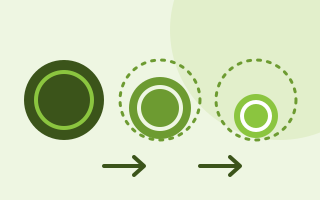
- Phase it in. The money waits in cash or a money market investment and moves into the market in equal parts over a set number of months. This spreads your entry over several prices and can soften the regret of investing just before a fall. The trade-off: the waiting money may miss out if markets rise in the meantime.
Three routes into the market
Illustration- New money in
- Already invested
- Waiting in cash
Nobody knows in advance which route will turn out better. For many people the deciding factor is temperament: a phased entry you can stick with may serve you better than an all-at-once entry you abandon after a sharp fall. If you phase in, fixing the schedule beforehand and letting it run automatically helps to keep it from becoming a wait for the “perfect” moment.
Nor need it be either-or: many people invest a lump sum and keep a debit order running alongside it.
Keep pace with inflation
A debit order that stays at the same rand amount for years is quietly shrinking: as prices rise, the same contribution buys less. Many investments let you build in an automatic annual increase — sometimes called an escalation — so that your contribution steps up every year without your having to remember.
You can generally choose the rate or link it to inflation. Timing it with your annual salary review tends to make it easier to absorb.
An emergency fund comes first
Before either route, it is generally sensible to have an emergency fund: easily accessible cash for surprises such as a car repair, a medical bill or a gap in income. How much is enough depends on your household and how secure your income is.
Market-linked investments can be down at exactly the moment you need cash. Without a buffer, an unexpected expense may force you to sell at a poor price, stop your debit order or borrow at a high interest rate. If a lump sum arrives before you have a buffer, setting part of it aside is often the first thing to discuss.
How VyroPlus helps
VyroPlus is an authorised Financial Services Provider based in Kimberley, and investments are one of the eight areas we help with. Whether you are starting a debit order or deciding about a lump sum, a conversation usually covers:
- your goal, your time frame and how much movement in value you are comfortable with;
- whether emergency money and short-term debt come first;
- a monthly contribution you can keep up, with an annual increase that suits your budget;
- for a lump sum, the tax position and whether to invest at once or phase in.
There is no obligation, and no return is ever guaranteed. The aim is that you understand what you are choosing and why.
Questions to ask
Before you start a debit order or invest a lump sum, it helps to have answers to these:
- Do I have an emergency fund?Enough accessible cash that a surprise will not force you to sell.
- What amount can I keep up every month?A smaller contribution you can sustain is generally more useful than a larger one you cancel.
- If I phase in a lump sum, where does the rest wait?What the waiting money earns and whether the schedule runs automatically.
- What will it cost me?Ask for every fee in writing, including any minimum amounts.
Next step
Talk to us about investments
Send us a note through the contact form and we will arrange a time that suits you — in person in Kimberley or by phone.